
The Second Sino-Japanese War (1937–1945) was a major conflict between the Republic of China and the Empire of Japan, beginning with the Marco Polo Bridge Incident and merging into World War II. Japan’s invasion led to a brutal, eight-year war of attrition, with over 15–25 million Chinese casualties and the eventual defeat of Japan in 1945
Start of War: While tensions began with the 1931 Japanese invasion of Manchuria, full-scale war broke out on July 7, 1937, following the Marco Polo Bridge Incident.
The Conflict: Japan quickly occupied key cities like Shanghai and the capital, Nanjing, leading to the infamous Nanjing Massacre.
Strategy and Resistance: Chinese forces, led by the Nationalists (Kuomintang) and the Chinese Communist Party, avoided major, direct battles in favor of a war of attrition, while Japan failed to achieve a decisive victory.
Shift in 1941: Following the attack on Pearl Harbor, the war became formally part of the global World War II, with China receiving support from Allied powers like the U.S. and Britain.
End of War: Japan’s surrender in 1945, following atomic bombings and the Soviet invasion of Manchuria, concluded the war, resulting in China regaining lost territories, such as Taiwan.
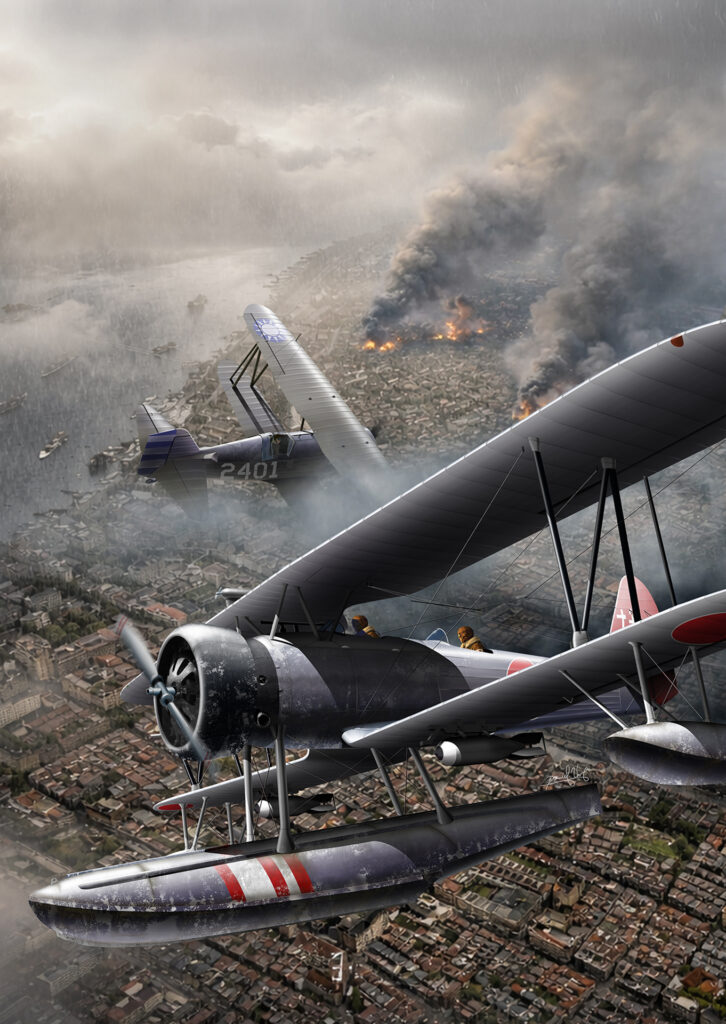
This image shows an aerial combat over China under a hurricane storm.
This work was done as a book cover for Helion Publishing.