
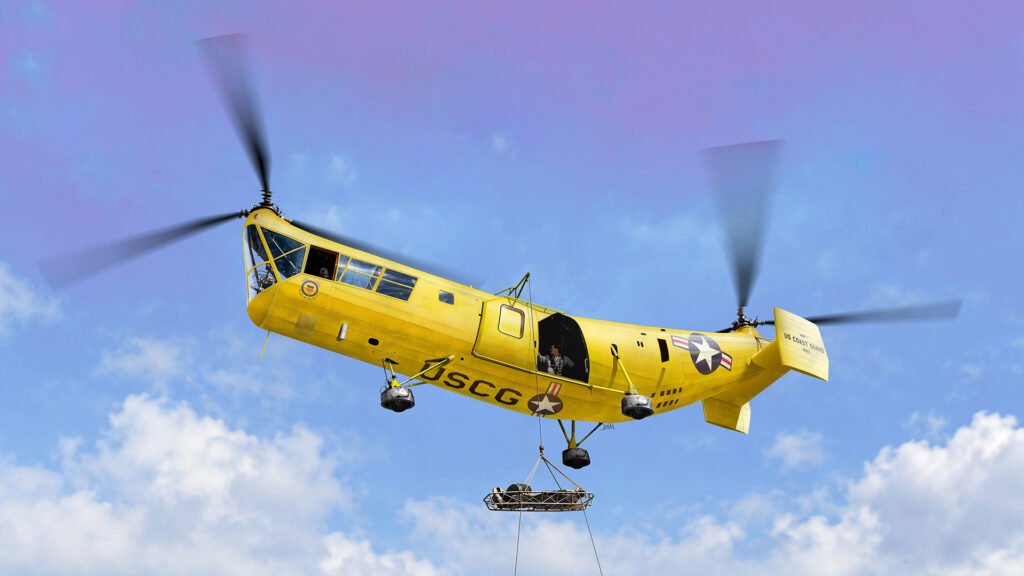
HRP-1 Rescuer — Illustration Development
The development of the HRP-1 Rescuer, better known as the “Flying Banana”, began with a structural line drawing.

At this stage, the focus is on establishing the aircraft’s proportions, geometry, distinctive shapes and technical details. Working primarily with lines makes it possible to study the form clearly and refine the construction before introducing any colour or surface treatment.
The second stage transforms this foundation into the finished illustration. Colour, shading, materials, markings and atmospheric details are gradually added while preserving the accuracy and character established in the initial drawing.
The two stages show how a technically structured drawing can evolve into a fully rendered historical aircraft illustration.
About the Flying Banana
The Piasecki HRP-1 Rescuer, famously nicknamed the “Flying Banana,” was the world’s first successful tandem-rotor helicopter, designed by Frank Piasecki and built by the Piasecki Helicopter Corporation.
Key Facts:
- First Flight: March 7, 1945 (prototype PV-3 / “dogship”)
- Operators: United States Navy, United States Marine Corps, and United States Coast Guard
- Engine: Pratt & Whitney R-1340-AN-1 radial engine (600 hp)
- Capacity: Two crew members and 8 to 10 passengers, or 2,000 lb (907 kg) of cargo
- Total Built: 28 units